

Is The HDB Upgrade Path Changing?
Overview
Singapore’s HDB resale market is showing signs of cooling.
Prices fell for the second consecutive quarter, the first back-to-back decline in nearly seven years, even as private home prices continued rising.
For HDB owners planning to upgrade, that gap may reduce the buffer they have for their next purchase.

The HDB-To-Condo Path Is Changing
For many Singaporeans, an HDB flat is both a home and the biggest asset they own.
It also plays a major role when they plan their next property move.
The usual path was straightforward.
Buy a BTO, complete the five-year Minimum Occupation Period (MOP), sell the flat, and use the gains to move into private property.
That path still exists.
But it is no longer something buyers should assume will work the same way for every household.
When HDB resale prices soften, owners may have less room to work with after selling.
At the same time, if private home prices continue rising, the next purchase may require more planning.
HDB flats are primarily built as homes, not investment vehicles.
When demand rises, supply can be adjusted to keep public housing accessible.
That helps the broader market, but it also means buyers should not rely on HDB appreciation alone to fund their next move.
Why The Two Markets Are Moving Differently
HDB and private homes are not driven by the same group of buyers.
That is why their prices do not always move in the same direction.
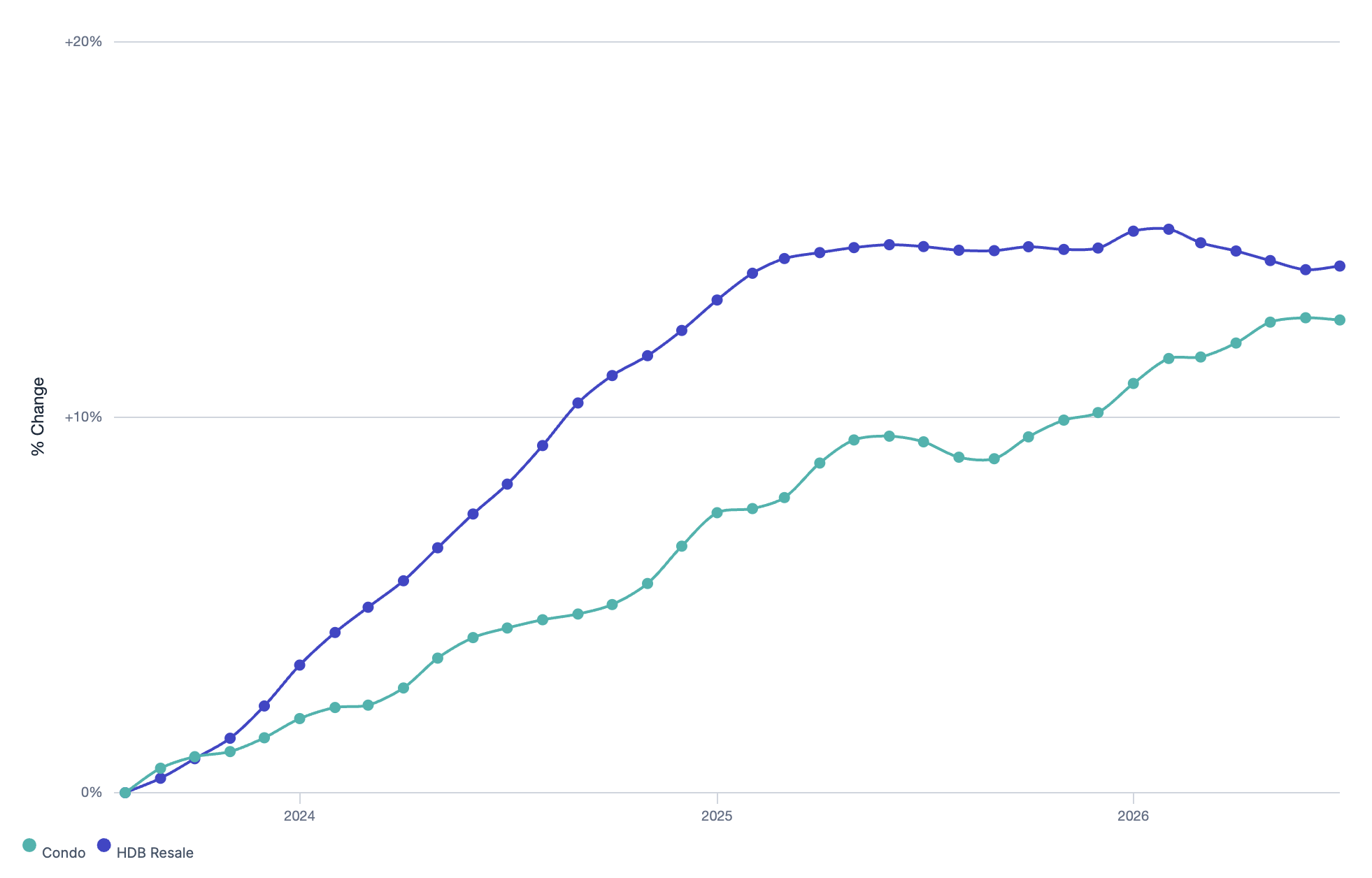
(Source: Real Insight)
OCR (Outside Central Region) condos tend to rely more on HDB upgraders.
When HDB resale prices fall, some upgraders may receive lower proceeds from selling their flat.
That can affect how much they are willing, or able, to pay for the next property.
For OCR projects, this matters because a large part of the buyer pool often comes from nearby HDB estates.
CCR (Core Central Region) projects are different.
Buyers in prime areas are usually less dependent on HDB resale proceeds.
They may include higher-income locals, permanent residents, investors, or foreigners relocating to Singapore.
This is why some CCR prices can continue rising even when HDB resale prices are flat or falling.
But this does not mean OCR is weak.
It depends on the buyer pool.
An OCR project near a large number of flats reaching MOP may still see strong upgrader demand.
A project without that nearby upgrader pool may be more affected when the HDB resale market slows.
For buyers, the question is not just where the project is located.
It is also who the future buyer is likely to be.
What The URA Master Plan Shows
When broad market gains are less automatic, buyers need to look more carefully at what is planned around a project.
A project can be in the same region as another, but the surrounding plans may be very different.
New jobs, transport links, homes, retail and office space can change how people use an area over time.
Jurong Lake District is one example.
It has been planned as Singapore’s second CBD, with new housing, office space, transport links and mixed-use developments expected to come in over time.
The Town Hall Link white site also shows how the area is expected to grow.
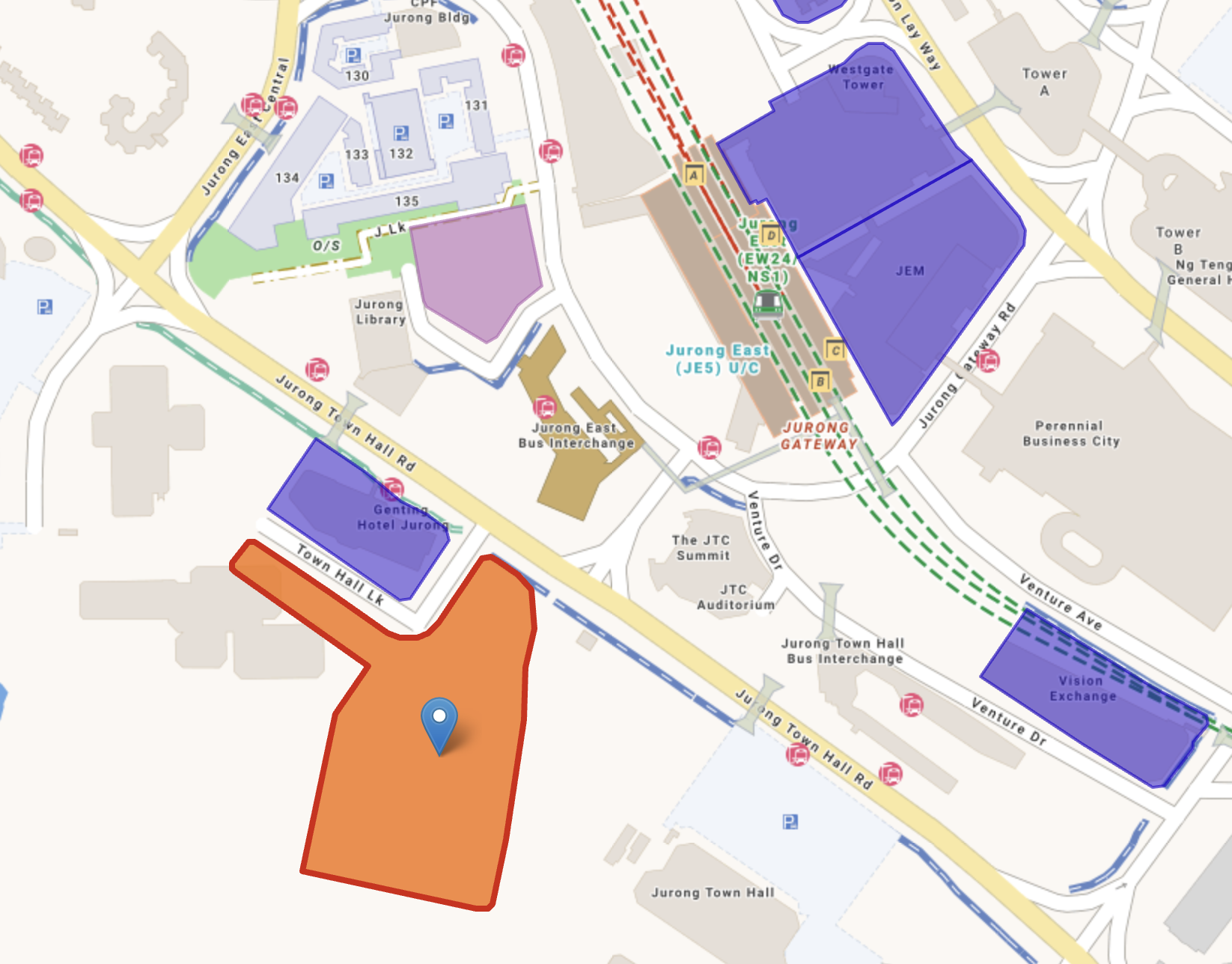
(Source: URA)
This does not mean every project in a growth area will perform well.
But it does mean buyers should look beyond today’s location.
The URA Master Plan helps show how an area may change, and whether future demand is likely to be supported by jobs, transport and new amenities.
What To Review Before Upgrading
For HDB owners planning to upgrade, the first step is to work out the actual numbers.
That means checking how much the flat can sell for, how much loan is left, how much CPF has been used, and how much cash is available after selling.
This helps buyers understand whether the next purchase is still within reach.
The next step is to look at the buyer pool.
For OCR projects, nearby HDB estates matter because many future buyers may come from upgraders in the area.
If many flats nearby are reaching MOP, that can support future demand.
If the upgrader pool is smaller, the project may depend more heavily on pricing, location and product fit.
Buyers should also compare the project against the wider market.
Look at new launch prices, resale prices, and the latest OCR, RCR (Rest of Central Region) and CCR medians.
This helps show whether the price is fair, stretched, or still reasonable for the area.
Growth areas often attract attention quickly, especially when new launches are tied to future plans.
But before committing, buyers should still check whether the purchase fits their actual budget and long-term plans.
Summary View
Upgrading from HDB to private property is still possible.
But the decision now needs more careful planning than before.
As HDB resale and private home prices move differently, buyers need to look beyond broad market averages.
The next purchase should be assessed based on actual affordability, future buyer pool, surrounding supply, and what is planned for the area.
In this market, the right project matters more than simply moving from HDB to private property.

If you are still paying over 2% for your home loan, then now's a good time to talk to Moshin!
Moshin is Singapore's first AI-Powered Loan Advisor, ready to assist you 24/7 and best of all, it's totally free for you. Start your refinancing or home loan conversation with Moshin today!
Chat with Moshin or visit Moshin's home to find out more 🐾
Disclaimer: The information and insights provided in this article are for informational purposes only and are based on Crestbrick’s independent research and views. While we strive to ensure accuracy and reliability, we do not guarantee the completeness, correctness, or timeliness of the data presented. Real estate investments are subject to various risks, including but not limited to market fluctuations, changes in economic conditions, interest rate volatility, regulatory shifts, liquidity constraints, and unforeseen property-specific risks. Past performance is not indicative of future results, and investment outcomes may vary. This article does not constitute investment, financial, or professional advice and should not be relied upon as such. Investors should conduct their own due diligence and seek advice from qualified professionals before making any investment decisions.